AI Didn't Kill Copywriting. Generic Copywriting Did.
What My Hair Taught Me About Fighting the Inevitable
I have curly hair. Every morning, I spend thirty minutes blowing it straight. I fight the thing my hair actually wants to do, and I win, and the results are honestly amazing. But here's what that thirty minutes taught me: you can force an outcome onto something stubborn if you understand exactly how it works and you're willing to put in the effort. What you can't do is convince millions of other people to stop wanting what they want.
That's the position a lot of copywriters and web designers have put themselves in this year. There's a wave of content out there telling people not to use AI to write their website copy, their emails, their blog posts. It's well-meaning. It's also, I think, needy. It comes from a place of fear rather than confidence, and it's asking people to do something they're never going to do, which is give up a free or nearly free tool that saves them hours of work.
Telling people to stop using AI to write their content is a little like telling people not to use the internet back when it first showed up. Nobody stopped. Nobody was ever going to stop. The people who tried to hold that line didn't slow anything down. They just spent their energy on a fight they were never going to win, instead of spending it on the thing that actually mattered.
The Real Problem With AI Copywriting Isn't AI
So let's say the quiet part out loud. AI isn't going anywhere. People are going to keep using it to write their websites, and no blog post from a copywriter is going to talk them out of it. But here's the thing almost nobody in my industry is saying next: that's fine. Because the thing that made copywriting valuable was never really the sentences.
Think about the last time you visited a business's website and actually trusted it enough to buy something. You weren't thinking about who wrote the words. You weren't checking whether a human typed the headline or an algorithm did. You were responding to something else entirely: did this business seem to understand your problem, did it make you feel like the solution was within reach, did it give you a reason to believe them over the ten other options open in your other tabs. Nobody has ever cared who wrote the words on a website. They care whether the words did their job.
That's where the real gap is, and it's not a gap AI closes on its own. AI doesn't know your specific audience. It doesn't know what your customer is feeling in the moment they land on your page, the frustration or the fear or the exhaustion that brought them there looking for a solution. It doesn't know to ask you for your credentials, or to suggest you put your certifications where a nervous first-time buyer will actually see them. It won't think to tell you a testimonial needs to sit right where someone's biggest objection shows up, or that a photo of someone actually enjoying your product does more emotional work than any adjective you could write. AI can generate a paragraph. It has no idea where that paragraph needs to go, or why, unless a person who understands persuasion tells it.
That's the part that isn't going away, because it was never really about typing. It's about structure. It's about knowing what a stranger needs to feel, in what order, before they trust you enough to hand over their money. You can hand a person the most technically fluent AI writing tool in the world, and if nobody tells it how to build that structure, it'll produce a page that reads fine and converts nothing. I see this constantly. Someone tries the DIY version, gets a website that looks perfectly professional, and can't figure out why it isn't bringing in a single lead.

Most business owners know they should be collecting testimonials and client feedback, but they aren’t sure what to ask—or how to ask in a way that actually produces useful, credible proof. Vague requests lead to vague responses, and great client experiences often go undocumented.
That’s why I created Proof Builder—a strategic feedback system that shows you exactly what questions to ask, when to ask them, and how to turn real client responses into strong, trust-building testimonials.
Instead of awkward requests or unusable blurbs, you’ll walk away with clear, permission-based proof you can confidently use across your website and marketing.
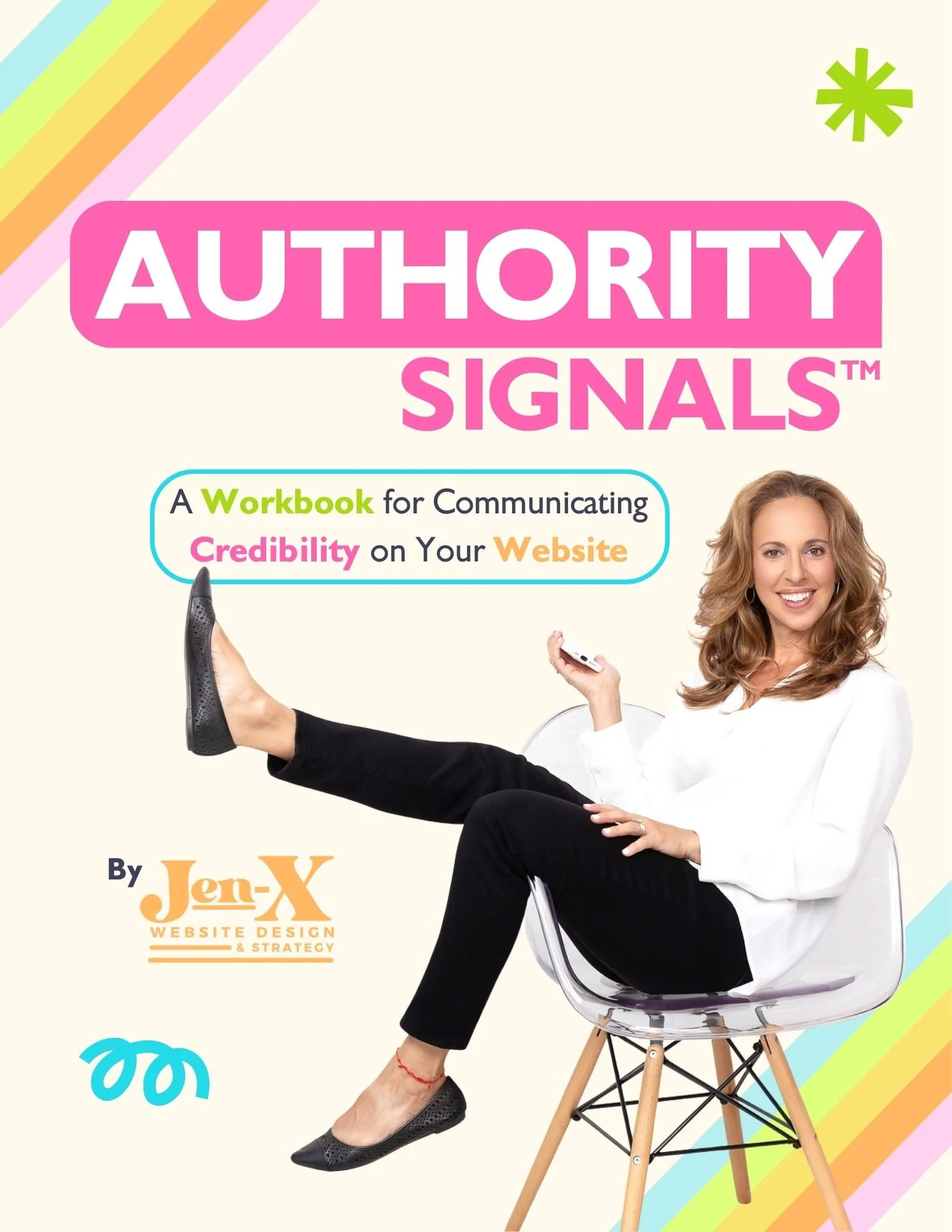
Most business owners already have credibility—but their website doesn’t always show it. Some overlook authority they didn’t realize they had. Others know their expertise but struggle to communicate it clearly in a way visitors can quickly understand.
That’s why I created Authority Signals—a practical, fill-in-the-blank workbook that helps you uncover the authority you may be missing and clarify how to convey the authority you already know you have, using proven website signals like testimonials, statistics, credentials, logos, awards, and press.
Instead of guessing what to say or overloading your site, you’ll identify the proof that actually matters—so visitors can recognize your value quickly and feel confident choosing you.
What Actually Fixes Generic Copywriting
So instead of fighting AI, I built around it. I use it. I tell it exactly how to structure a page, what emotional beats need to land where, what proof needs to show up before the ask. What I hand back to a client isn't just AI-generated copy. It's copy built on a framework, the same one I've used for years to figure out what actually makes a stranger trust a business enough to become a customer. The tool changed. The thinking behind the words didn't.
If you've been putting off updating your website because you didn't want to pay someone thousands of dollars, or because you tried the AI route yourself and it came out sounding like everyone else's AI-written site, that's usually not an AI problem. It's a structure problem. And it's a much easier one to fix than people think, once someone shows you where the pieces actually go.
FAQ
Q1: Is AI copywriting bad for my website?
A1: Not on its own. AI can produce clean, grammatically correct sentences all day long. What it can't do without direction is decide what your specific audience needs to feel, in what order, before they trust you enough to buy. AI copywriting becomes a problem when nobody gives it that structure, not because a machine was involved in writing the sentences.
Q2: Can I just use AI to write my whole website myself?
A2: You can, and plenty of people do. The results are usually fine on a sentence level and flat everywhere else, because most business owners don't know what to tell the AI to prioritize: where trust signals belong, how to sequence a visitor's doubts, what proof needs to show up and when. If your site reads correctly but isn't bringing in leads, that gap is usually why.
Q2: If AI can write copy, why hire a copywriter at all?
A2: Because the writing was never really the hard part. The hard part is knowing your audience well enough to know what they need to hear, and knowing persuasion well enough to know where to put it. A copywriter who uses AI well is directing that structure on your behalf, then using AI to help execute it faster, rather than handing you words with no strategy behind them.
Q2: What's the difference between generic copywriting and strategic copywriting?
A2: Generic copywriting describes what your business does. Strategic copywriting is built around what your customer is feeling and what they need to believe before they'll trust you, then structures the page to move them through that in order. Both can technically be written by AI. Only one of them tends to convert.

This page contains affiliate links